This is probably the most elementary and simple question for a marketer.
Sort of feels like it’s too basic of a question.
But if you ask 10,000 marketers, everyone will give you different answers.
Here’s how I see it:
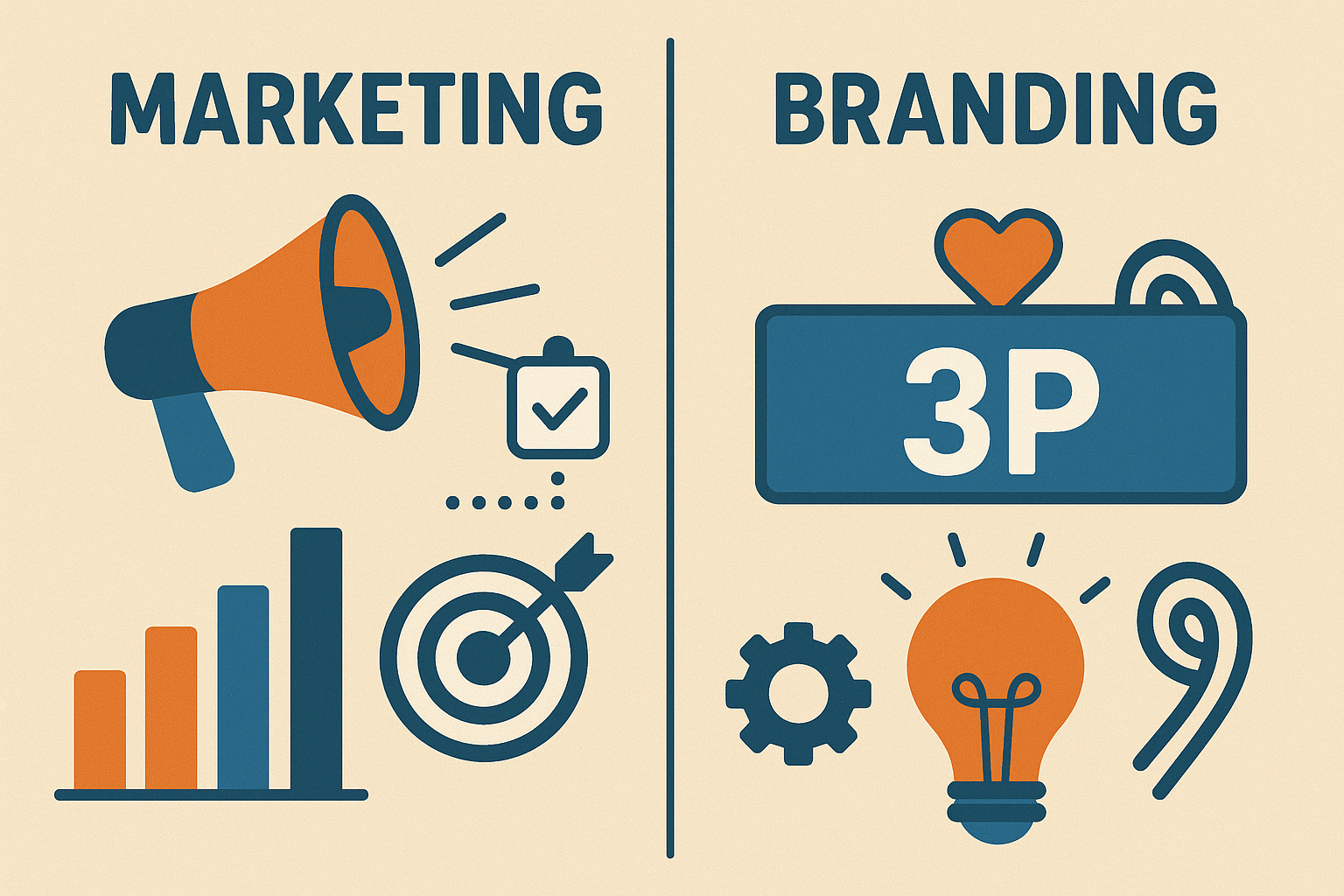
Branding – 3P
1 – Predictable
2 – Preferred
3 – Positioning
For each P, I’ll share 2 examples, 1 for B2C and 1 for B2B.
Predictable
How can we craft a predictable experience for the customer so the brand stays in the mind.
For example, if you go to McDonald’s all over the world, the experience is super predictable, as a customer you know what you are getting.
As for B2B, I love the example of hosting company like Serverfreak, whenever I buy domain and hosting from them I get the same experience each time and if there are issues, the live chat is on 24/7 and reply within seconds no matter what time I start a chat.
I guess predictable experience comes from multiple repeated experiences with the brand. It can’t just happen once or else it won’t be predictable.
Preferred
The second P is Preferred, how do we build a brand that is trustworthy.
Imagine choosing to buy a phone. One has Apple logo on it and one ad online shows an Orange (hypothetical) logo.
Which brand you trust more?
You will probably choose Apple because they have built trust over the years. If there are issues with Apple phone, you know where to go to fix the issue. Apple also pride themselves with providing users with enhanced privacy. Each time you download an app, Apple will make sure your privacy is protected.
As for Orange phone (again, hypothetical), you may see many ads appear in social media, but still it’s hard to buy because you don’t really trust the brand yet, making Apple the preferred choice.
Of course what Orange can do then is to get targeted influencer/celebrity to promote their phones to make it more trustworthy. This is another P, positioning which we will discuss below.
Moving onto the B2B example, the current no.1 B2B company is Nvidia. Why do companies like Meta, Tesla, OpenAI etc buy from Nvidia? It’s because they have built the best chips in the market. In Nvidia’s case, they build trust by being the best and also delivering the first P, predictable chips that works great.
Positioning
On the final P, which I think is the most interesting one.
How do you position your brand and stand out from the competition.
Linkedin is a great example. Had Linkedin tried to fight Meta to be the best in social media, they would have lost. But instead they niche down to position themselves as social media for professionals and they won that pie comfortably.
Tiktok is doing the same with short + entertaining videos positioning.
For the B2B example, my marketing agency, Axcel Digital has the positioning of being a healthcare marketing agency instead of an agency that serves every business.
A Simple Method to Remember 3P
1 – Positioning: Who do you want to target?
2 – Predictable: How is the entire customer experience? Can we make it the same for all customers?
3 – Preferred: Why should customers choose you?
3P Among Stakeholders
Besides the 3P, in the real world, branding is also a 3P between 3 parties, you as a company, your clients/customers, and your employees. Everyone needs to be aligned on the 3P of your brand for your company to develop solid brand awareness.
Marketing
Once the branding 3P is set, then only marketing should come in.
I think in real life marketing actually happens before branding, which makes the marketing weak.
I define marketing as strategies used to amplify branding.
So marketing channels can be pretty broad but no matter you are using Facebook, Tiktok, Newspaper, Billboard etc, the marketing message has to match the 3P branding or else it’s purely shouting out loud and gathering useless impressions that looks good on paper but doesn’t really build the brand.
Combining Both
Both branding and marketing is reliant on each other.
Without branding, marketing will be a waste of money because the messaging will be unclear and all over the place.
Without marketing, no one knows your brand even exist.
Conclusion
I really love this question because it forces you to think deep what is the distinct difference between branding and marketing and how both are reliant on each other.